
Guide for parents
Coloring from age 2 to 5: what to expect
A 2-year-old scribbles across the whole page. A 5-year-old colors close to the lines. Here is what usually happens in between, and how you can help at each age.
One page, colored at four ages
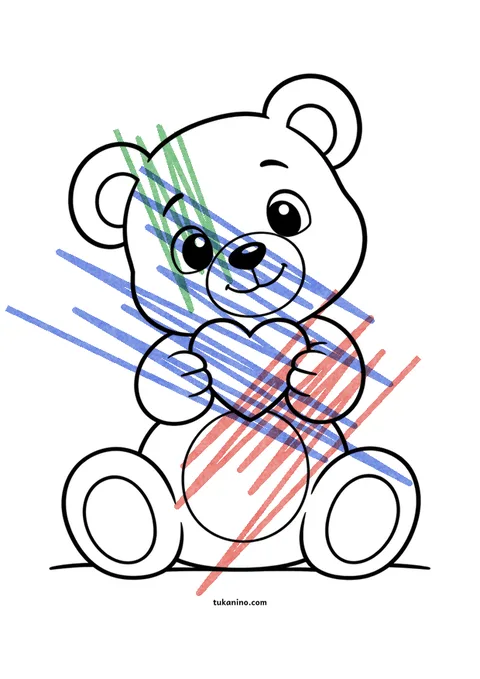 Age 2
Big scribbles that go right over the lines.
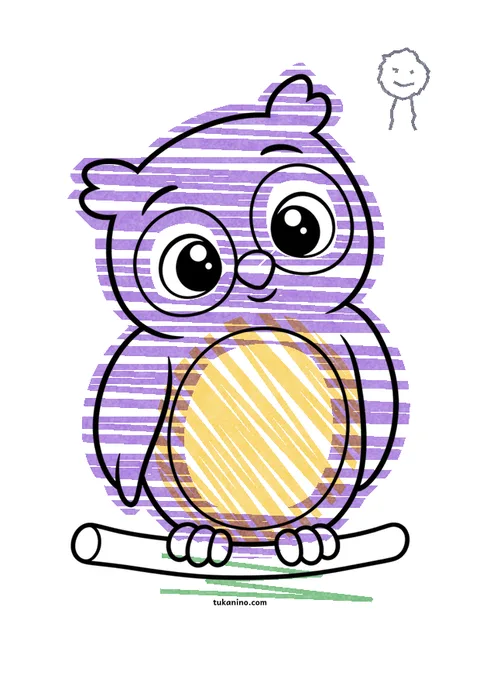 Age 3
Color lands on the big shapes. A first tadpole person.
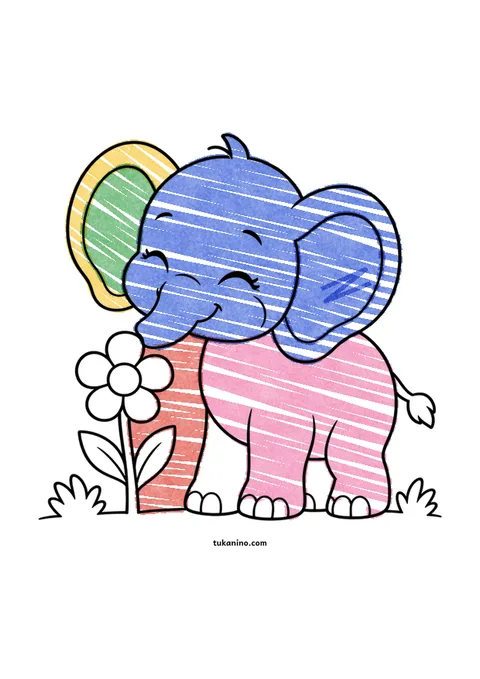 Age 4
Each shape gets a color, often across the lines.
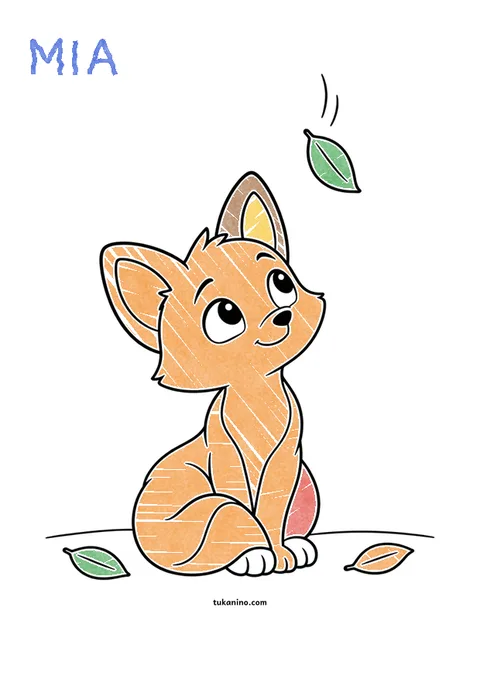 Age 5
Close to the lines, and maybe a name.
We made these four examples from Tukanino pages to show the usual direction of change. They are not real children's work, and every child moves at their own pace.
Milestones on one ruler
Each marker is one skill, placed at its age. Filled dots are things most children can do by that age, from the CDC checklists.1 Hollow dots show when about half of children can do it, from a standard motor test.2
- By 18 monthsScribbles1
- About 2¼ yearsCopies a line2
- About 2¾ yearsCopies a circle2
- By 3 yearsDraws a circle after you show how1
- About 3¼ yearsCopies a cross2
- By 4 yearsHolds a crayon with fingers and thumb1
- About 4 yearsCopies a square2
- By 5 yearsWrites some letters of their name1
- About 5 yearsColors between the lines2
- Most children (at least 3 in 4) by this age
- About half of children by this age
Age 2: Big scribbles
What you might see
Most children scribble by 18 months.1 At 2, coloring is mostly big, fast scribbles, often right off the edge of the page. Many toddlers hold the crayon in a fist.2 Many also switch hands. A steady hand preference often shows only around age 6.3
What helps
Choose pages with one big character and very thick lines. Stop when your child loses interest. Try a short piece of crayon. In one study of 2-year-olds, a small piece of crayon led to a more grown-up grip than a pencil.4
Age 3: Circles and tadpoles
What you might see
By 3, most children can draw a circle after you show them how.1 A child's first drawing of a person is often a “tadpole”: a big round head with two lines for legs. Tadpoles tend to appear from about 3.5 The grip starts to change too. In one study, about half of children aged 3 to 3½ already held the crayon with thumb and fingers.6
What helps
Draw a circle slowly while your child watches, then hand over the crayon. Pages with one character and big areas still work best. A mix of scribbles and careful strokes on one page is normal.
Age 4: Thumb and fingers
What you might see
By 4, most children hold a crayon between fingers and thumb, not in a fist. Most also draw a person with three or more body parts.1 About half can copy a cross by 3¼ and a square by 4.2 Drawings vary a lot at this age. In one study of 4- and 5-year-olds, some children still scribbled, some drew tadpoles and some drew a full body.7
What helps
Try pages with a few more shapes and small extras. Don't push for a perfect grip. Children use several grown-up grips. In a study of 9- and 10-year-olds, these grips gave equally fast and neat handwriting.8
Age 5: Close to the lines
What you might see
By 5, most children can write some letters of their name.1 Coloring gets neater step by step between 3 and 6.9 In one standard motor test, about half of children color between the lines by about age 5.2 Copying a triangle usually comes around 5 too.10
What helps
Pick pages with small details to fill. Invite your child to draw their own extras around the picture and to write their name on it.
These ages are guides, not tests
The CDC milestones are things at least 3 in 4 children can do by a certain age.111 So many children do them earlier. Children grow at their own pace.
Talk with your child's doctor if your child can't yet do several of these things, has lost a skill, or you are worried. Don't wait.1 For 3- to 4-year-olds, the American Academy of Pediatrics lists trouble scribbling, not copying a circle, and not holding a crayon between thumb and fingers among the signs to raise with your doctor.12
Find pages for your child's age
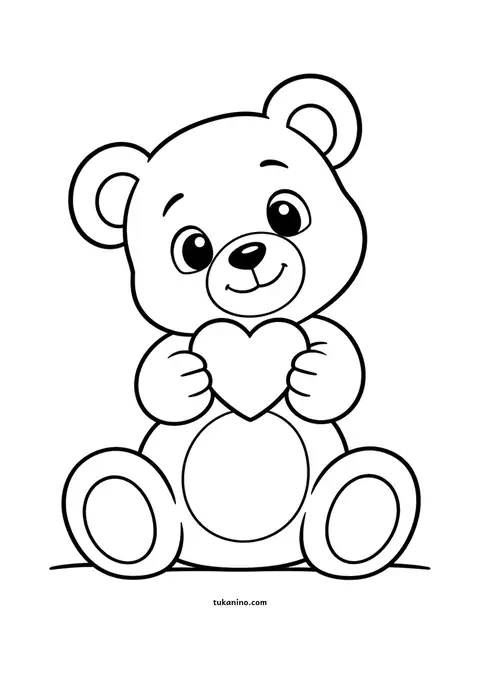
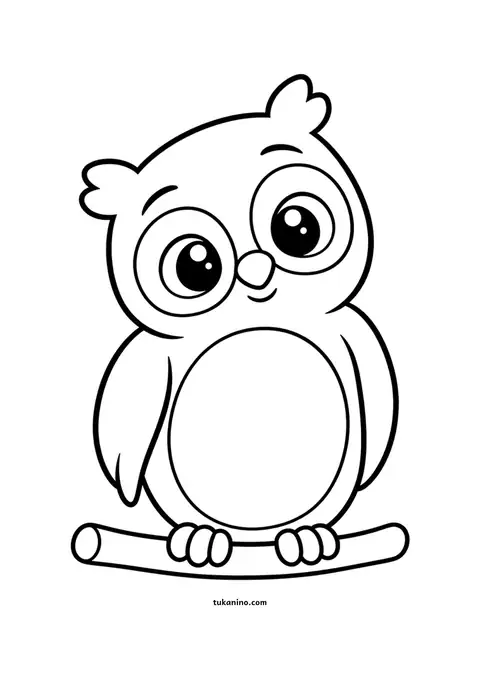
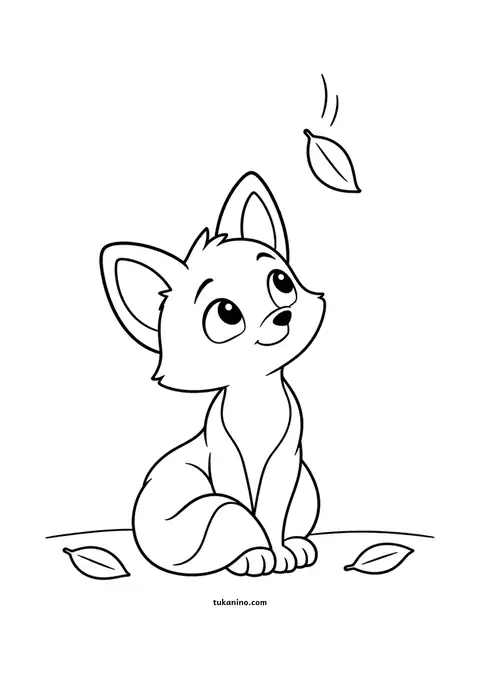
Very simple pages suit most 2- and 3-year-olds. Simple pages add a few more shapes for 4- and 5-year-olds. Let your child choose.
Questions parents ask
When do children start coloring inside the lines?
Later than most parents expect. Coloring gets neater step by step between 3 and 6.9 In one standard motor test, about half of children color between the lines by about age 5.2
Should I correct my child's crayon grip?
Usually not. Most children move from a fist to thumb and fingers by 4.1 Several grown-up grips work equally well later on.8 If your child still holds a crayon in a fist at 4, mention it to your doctor.12
Do toddlers need chunky crayons?
Not necessarily. In one study of 3- to 5-year-olds, wider tools led to less mature grips.13 In another, 2-year-olds held a small piece of crayon in a more mature grip than a pencil.4
Is my child left- or right-handed?
It may be too early to tell. Young children often switch hands. A steady preference often shows around age 6, but researchers don't fully agree on the exact age.3
Sources
Every claim on this page links to one of these sources. We read each one and note who was studied.
- 1
- 2ReviewDosman, C. F., Andrews, D., & Goulden, K. J. (2012). Evidence-based milestone ages as a framework for developmental surveillance. Paediatrics & Child Health, 17(10), 561–568.doi.org/10.1093/pch/17.10.561Ages by which 50% of children master each skill, from the Peabody motor scales (PDMS-2).
- 3ReviewScharoun, S. M., & Bryden, P. J. (2014). Hand preference, performance abilities, and hand selection in children. Frontiers in Psychology, 5, 82.doi.org/10.3389/fpsyg.2014.00082Literature review. 3- and 4-year-olds are the least consistent in hand use.
- 4StudyYakimishyn, J. E., & Magill-Evans, J. (2002). Comparisons among tools, surface orientation, and pencil grasp for children 23 months of age. American Journal of Occupational Therapy, 56(5), 564–572.doi.org/10.5014/ajot.56.5.56451 children aged 23 to 24 months.
- 5StudyGernhardt, A., Rübeling, H., & Keller, H. (2015). Cultural perspectives on children's tadpole drawings. Frontiers in Psychology, 6, 812.doi.org/10.3389/fpsyg.2015.00812924 children aged 3 to 6 in seven countries. Tadpoles appeared in every group.
- 6StudySchneck, C. M., & Henderson, A. (1990). Descriptive analysis of the developmental progression of grip position for pencil and crayon control in nondysfunctional children. American Journal of Occupational Therapy, 44(10), 893–900.doi.org/10.5014/ajot.44.10.893320 children aged 3 to 6. 48% of the youngest and 90% of the oldest used a mature grip.
- 7StudyBoyatzis, C. J., Michaelson, P., & Lyle, E. (1995). Symbolic immunity and flexibility in preschoolers' human figure drawings. The Journal of Genetic Psychology, 156(3), 293–302.doi.org/10.1080/00221325.1995.991482428 children aged 3 years 11 months to 5 years 8 months, US.
- 8StudySchwellnus, H., Carnahan, H., Kushki, A., Polatajko, H., Missiuna, C., & Chau, T. (2012). Effect of pencil grasp on the speed and legibility of handwriting in children. American Journal of Occupational Therapy, 66(6), 718–726.doi.org/10.5014/ajot.2012.004515120 children in Grade 4, Canada.
- 9StudyHuang, C.-Y., Lin, G.-H., Lu, S.-C., & Lee, S.-C. (2024). Quantifying coloring skills among preschoolers. American Journal of Occupational Therapy, 78(3).doi.org/10.5014/ajot.2024.050519239 children aged 3 to 6, Taiwan. Coloring got neater with age.
- 10StudyBrittain, W. L. (1976). The effect of background shape on the ability of children to copy geometric forms. Child Development, 47(4), 1179–1181.doi.org/10.2307/112845953 nursery-school children, US. States the usual norms: circle at 3, square at 4, triangle at 5.
- 11StudyZubler, J. M., Wiggins, L. D., Macias, M. M., Whitaker, T. M., Shaw, J. S., Squires, J. K., et al. (2022). Evidence-informed milestones for developmental surveillance tools. Pediatrics, 149(3), e2021052138.doi.org/10.1542/peds.2021-052138Expert review behind the 2022 CDC checklists. Milestones were picked so that 75% or more of children reach them by that age.
- 12GuidelineAmerican Academy of Pediatrics. (2023). Developmental milestones: 3 to 4 year olds. HealthyChildren.org.healthychildren.orgParent guidance, adapted from the book Caring for Your Baby and Young Child, 7th edition.
- 13StudyBurton, A. W., & Dancisak, M. J. (2000). Grip form and graphomotor control in preschool children. American Journal of Occupational Therapy, 54(1), 9–17.doi.org/10.5014/ajot.54.1.960 children aged 3 to 5.
No source matches that search.